
Academic Advance Partners
Guiding RCU Institutions to R2 Designation
Discover. Align. Advance
R2 Opens Doors
Achieving R2 designation brings more than prestige. It is a strategic inflection point that reshapes what your institution can do and who it can attract.
Funding eligibility expands Unlocks federal grant programs, foundation awards, and research partnerships currently out of reach.
Faculty recruitment improves: Draws prospective faculty who value a serious research environment.
Student enrollment grows: Attracts prospective graduate students seeking a serious research environment and undergraduate students who want access to faculty-led research opportunities.
Learning experiences deepen: Enriches learning experiences for undergraduate and graduate students as faculty integrate their research into teaching..
Institutional reputation and leverage grows: Reshapes how policymakers, agencies, accreditors, rankings organizations, and philanthropists see and invest in your institution
Is R2 Your Institution's Next Designation?
The 2025 Carnegie Classification update opened new possibilities for institutions with research ambitions. The path to R2 designation is now more transparent and threshold-based: spend at least $5 million annually on research and development and award at least 20 research doctorates per year, with no cap on the number of institutions that can qualify.
For institutions now designated as Research Colleges and Universities (RCU), this clarity is an invitation. Most institutional leaders recognize the advantages that R2 status brings. The question is how to get there: which gaps close, which investments to make, and how to build a strategy that fits your institution's mission, strengths, and story.
The path to R2 is not linear. Institutions reach the same designation through diverse combinations of research investment, doctoral program development, and institutional strategy, a concept known as equifinality. AAP helps RCU institutions find their path and navigate the journey to R2 designation.
R2 Designation is Within Reach
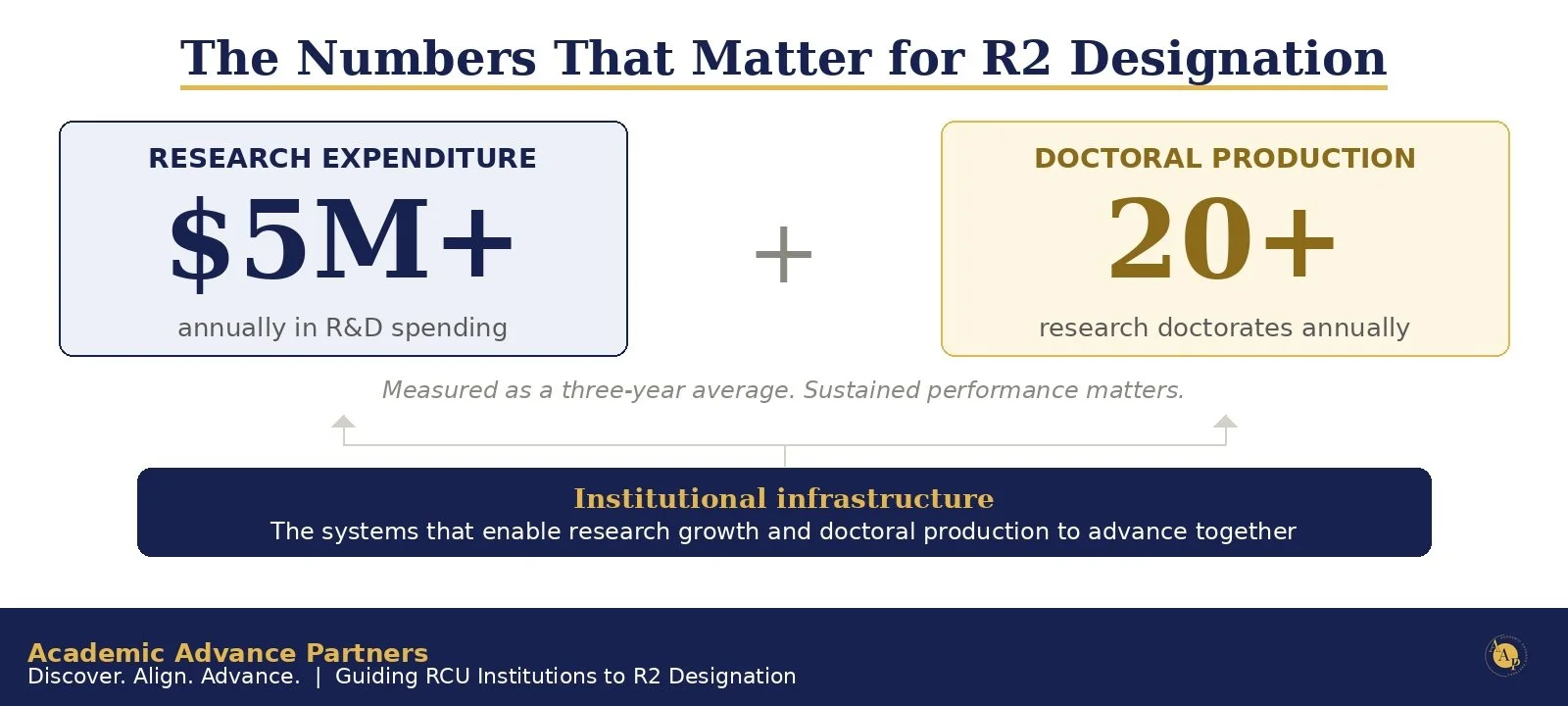
The path to R2 requires institutions to meet two specific thresholds simultaneously, measured as a three-year average. Achieving these thresholds depends on institutional infrastructure built to support research growth and doctoral production together.
What Can We Discover About Your Institution?
We have the tools. What will they reveal about your institution? Using AAP's proprietary tools and frameworks, institutions often uncover opportunities that traditional planning processes miss, including:
Pathways to increase annual research doctorate production through strategic expansion of existing doctoral programs
Alignment with federal funding priorities not currently reflected in grant strategy
Stronger connections among doctoral growth, funding, and workforce needs
A clearer picture of your institution's trajectory toward Carnegie R2 eligibility
Is your institution closer to R2 than you think?

Your R2 Journey. Our Expertise.
Most consulting firms that work in higher education are generalists. Academic Advance Partners (AAP) is not. We built our practice around a single goal: supporting RCU institutions through the journey to R2 designation.
That focus means we understand the Carnegie methodology, the NSF HERD survey, doctoral production requirements, and the mission-striving tensions that many institutions navigate on the path to R2. We bring that understanding to every engagement. Using AAP proprietary tools developed specifically for the RCU to R2 journey, we help institutions build pathways toward research growth, external funding expansion, and doctoral program development without losing sight of what makes each institution distinctive.
Every institution we work with is on the R2 journey. We are committed to making that journey reflect the unique story of each institution.